
Guide · Oct 22, 2026
Homemade Hummus: Classic and Roasted Red Pepper
Smooth homemade hummus in 10 minutes from one can of chickpeas, plus a roasted red pepper version, tips for creamy texture and a USDA nutrition estimate.
Last updated
Short answer: Blend 1/4 cup tahini with 3 tablespoons lemon juice until pale, add a garlic clove, cumin and salt, then a drained 15-ounce can of chickpeas. Stream in 2 to 4 tablespoons of ice water until it's smooth. It takes about 10 minutes and makes roughly 1 3/4 cups. For roasted red pepper hummus, blend in 3/4 cup jarred peppers.
Homemade hummus is mostly a food processor job. There's no cooking if you start with canned chickpeas, and the whole thing is done in the time it takes to wash the processor bowl. Make the classic version first, then try the red pepper one, which is sweeter and a little smoky.
Like every recipe here, this one was developed by Michael Gonzales from standard ratios. The full ingredient list, steps and nutrition estimate are in the recipe card below.
What you need
A food processor gives the smoothest result. A standard-size bowl is plenty for one batch, and a mini one also works if you scrape it down often. A high-speed blender works too, but it usually needs a little more liquid to keep things moving.
The other thing worth getting right is the tahini, a paste of ground sesame seeds. Look for a jar that lists only sesame seeds, and stir it well before measuring, since the oil separates and rises to the top. A runny, well-stirred tahini blends far more easily than the thick stuff from the bottom of an old jar.
How do you make hummus smooth and creamy?
Blend the tahini and lemon juice first, then add the chickpeas, then thin it with ice water. That order matters. Whipping the tahini and lemon on their own turns them pale and thick, and the chickpeas blend into that base more evenly than they would into a dry bowl.
- Give it time. Two full minutes of blending after the chickpeas go in makes a bigger difference than any trick.
- Use ice water, a tablespoon at a time, until it looks creamy. Stop when it's slightly looser than you want; it firms up in the fridge.
- Peel the chickpeas if you want it extra smooth. Pinch each one and the skin slides off. It's slow, so it's optional.
- Scrape the bowl. Stop and push everything down at least twice.
Classic or roasted red pepper: what changes?
Only three things. For the red pepper version, add 3/4 cup jarred roasted red peppers, drained and patted dry, along with the chickpeas, and blend in 1/2 teaspoon smoked paprika. Then cut the ice water to 1 tablespoon, because the peppers bring their own moisture.
| Classic | Roasted red pepper | |
|---|---|---|
| Base | 1 can chickpeas, 1/4 cup tahini, 3 tbsp lemon juice, 1 garlic clove | Same |
| Add-ins | 1/2 tsp ground cumin | Cumin plus 3/4 cup roasted red peppers and 1/2 tsp smoked paprika |
| Ice water | 2 to 4 tbsp | About 1 tbsp |
| Color and taste | Pale, nutty, lemony | Orange-pink, sweeter, a little smoky |
| Makes | About 1 3/4 cups | About 2 cups |
The red pepper batch comes out at about 2 cups, so the same can stretches to about eight 1/4-cup servings.
Can you make hummus with dried chickpeas?
Yes. It takes longer, but you decide how soft the chickpeas get. You'll need about 3/4 cup of dried chickpeas to get the 1 1/2 cups of cooked ones this recipe uses, since USA Pulses says half a cup of dry makes about a cup cooked [2].
Soak them first, either overnight in 3 cups of cold water per cup of chickpeas, or with USA Pulses' quick soak: boil for 2 minutes, then cover and let them stand for an hour [2]. Simmer the drained chickpeas in fresh water, 3 cups per cup, for 1 1/2 to 2 hours [2]. For hummus, cook them until they're very soft and mash easily between two fingers.
In a pressure cooker, USA Pulses suggests 17 to 18 minutes at high pressure for soaked chickpeas you plan to turn into hummus, then a 15-minute natural release [2].
Save a little of the cooking liquid. It works in place of the ice water and adds more chickpea flavor.
How long does homemade hummus last?
Three to four days in the fridge, in a covered container. That's the window USDA's Food Safety and Inspection Service gives for refrigerated leftovers, and FSIS also says not to leave perishable food at room temperature for more than 2 hours [3]. On a party table, put out a small bowl and refill it from the fridge rather than leaving the whole batch out all afternoon.
One allergy note: tahini is ground sesame. Sesame has been the ninth major food allergen in the U.S. since January 1, 2023, under the FASTER Act, FDA says [4], so mention it if you're bringing hummus to share.
What to eat with hummus
The obvious answers are good ones: warm pita, crackers, carrots, cucumber, bell pepper strips and snap peas. It also works as a spread in wraps and sandwiches, and a spoonful on a grain bowl doubles as a quick dressing.
If you like chickpeas as much as we do, try our chickpea salad sandwich or chickpea curry with coconut milk. There are more on our chickpea recipes page and our lunch recipes page.
Nutrition estimate
A 1/4-cup serving of the classic version comes out to about 140 calories, 4 g protein, 9 g fat, 11 g carbohydrate, 3 g fiber and 250 mg sodium, including the olive oil drizzle. We worked that out from USDA FoodData Central values for each ingredient [1].
For the red pepper version, the peppers add only about 20 calories to the whole batch. Jarred peppers vary a lot in sodium, though. Using USDA's value for canned red peppers, 3/4 cup adds about 1,400 mg to the batch, or roughly 180 mg per 1/4 cup, so check the label on your jar if you track it.
Sources
- U.S. Department of Agriculture, Agricultural Research Service. FoodData Central, SR Legacy: chickpeas, mature seeds, canned, drained, rinsed in tap water (FDC ID 173801); tahini, from roasted and toasted kernels (170189); lemon juice, raw (167747); garlic, raw (169230); oil, olive, salad or cooking (171413); spices, cumin seed (170923); salt, table (173468); peppers, sweet, red, canned, solids and liquids (168546). Accessed October 20, 2026.
- USA Pulses (USA Dry Pea & Lentil Council). How to Cook Dry Pulses. Accessed October 20, 2026.
- USDA Food Safety and Inspection Service. Leftovers and Food Safety.
- U.S. Food and Drug Administration. Food Allergies.
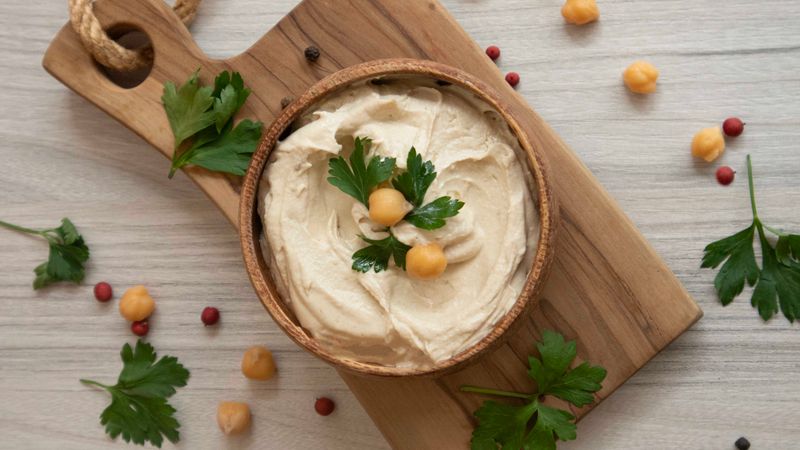
Photo: Delicious homemade hummus on cutting board by Lidya Kohen, via Pexels (Pexels license).
Swaps and substitutions
- Roasted red pepper: add 3/4 cup jarred roasted red peppers, drained and patted dry, with the chickpeas, plus 1/2 teaspoon smoked paprika. Start with just 1 tablespoon of ice water, since the peppers add moisture. It makes about 2 cups.
- No tahini: leave it out and blend in 1 to 2 extra tablespoons of olive oil. It will taste more of lemon and chickpeas and less nutty.
- Home-cooked chickpeas: use about 1 1/2 cups, cooked until very soft, and use some of their cooking liquid instead of the ice water.
- Milder garlic: use half a clove, or leave it out and add a pinch of garlic powder.
Classic Homemade Hummus
Smooth, lemony hummus made in a food processor from one can of chickpeas, tahini, lemon juice, garlic and ice water. The roasted red pepper version is in the swaps.
By Michael Gonzales
- Prep
- 10 min
- Cook
- 0 min
- Total
- 10 min
- Makes
- about 1 3/4 cups
Ingredients
- 1 can chickpeas, 15 ounces, drained and rinsed (about 1 1/2 cups), or the same amount home-cooked
- ¼ cup tahini, stirred well
- 3 tbsp fresh lemon juice, about 1 lemon
- 1 small garlic clove, peeled
- ½ tsp ground cumin
- ½ tsp salt, plus more to taste
- 3 tbsp ice water, 2 to 4 tablespoons, as needed
- 2 tbsp extra-virgin olive oil, 1 for blending, 1 to drizzle
- paprika and chopped parsley, to garnish, optional
Method
- Put the tahini and lemon juice in a food processor and blend for about 1 minute, scraping down the sides once, until the mixture turns thick and pale.
- Add the garlic, cumin, salt and 1 tablespoon of the olive oil and blend for another 30 seconds.
- Add the chickpeas and blend for 1 to 2 minutes, stopping to scrape down the bowl, until you have a thick, fairly smooth paste.
- With the motor running, add the ice water 1 tablespoon at a time until the hummus is smooth and creamy. You may not need all of it.
- Taste and add more salt or lemon juice if you like. Spoon it into a shallow bowl, make a swirl with the back of the spoon, drizzle with the remaining olive oil and sprinkle with paprika and parsley.
Food safety and storage
- Tahini is made from sesame, one of the nine major food allergens in the U.S.
- Keep hummus in a covered container in the fridge and don't leave it out for more than 2 hours.
- We'd eat it within 3 to 4 days, the window USDA gives for refrigerated leftovers.
Nutrition per serving (estimate)
140 kcal · protein 4 g · carbs 11 g · fiber 3 g · fat 9 g · sugars 2 g · sodium 250 mg
Estimate from USDA FoodData Central (SR Legacy) values for each ingredient. Values change with brands and portion sizes.
Frequently asked questions
How do you thin out thick hummus?
Blend in ice water or lemon juice, 1 tablespoon at a time, until it's as loose as you like. Hummus firms up in the fridge, so stir a splash of water into leftovers before serving.
Is homemade hummus healthier than store-bought?
It depends on the recipe and the brand. Making it yourself lets you choose how much salt, oil and tahini go in. By our USDA-based estimate, 1/4 cup of this classic version has about 140 calories and 250 mg sodium, so compare that with the label on your usual tub.
How long does homemade hummus last in the fridge?
Three to four days in a covered container. That's USDA's guidance for refrigerated leftovers. Don't leave it at room temperature for more than 2 hours.
Can you make hummus without tahini?
Yes. Leave the tahini out and blend in 1 to 2 extra tablespoons of olive oil. It will taste more of lemon and chickpeas and less nutty.
Can you make hummus without a food processor?
Yes. A high-speed blender works if you add a little more liquid and scrape it down often. You can also mash the chickpeas with a fork or potato masher for a chunkier spread.
Can you use dried chickpeas for hummus?
Yes. Soak about 3/4 cup dried chickpeas, then simmer them in fresh water for 1 1/2 to 2 hours, until very soft. That gives roughly the 1 1/2 cups this recipe needs. USA Pulses says half a cup of dry chickpeas makes about a cup cooked.
Is there a downside to eating hummus?
For anyone with a sesame allergy, yes. Tahini is ground sesame, and FDA lists sesame as one of the nine major food allergens in the U.S. Check with guests before you serve it.

Written by
Michael Gonzales
Health & fitness consultant
Michael has a diverse set of skills and passions, with a full-time career as an airline pilot and a dedicated focus on health and fitness consulting. He understands the importance of balancing a busy lifestyle with maintaining a healthy mind and body, and is committed to helping others achieve the same success. Michael's expertise in health and fitness is not just limited to physical training, but also extends to nutrition, stress management, and overall wellbeing. He takes a holistic approach to health and fitness, helping clients to achieve their goals in a sustainable and fulfilling way. With a strong desire to inspire and motivate others, Michael is always ready to share his time and knowledge with those who seek his guidance. Whether in the air or on the ground, Michael is dedicated to helping others live their best lives.