
Guide · Oct 21, 2026
How to Cook Quinoa, Rice, Lentils and Beans: Ratios and Times
Water ratios and cooking times for lentils, quinoa, rice and dried beans from USA Pulses, USA Rice and package directions, plus pressure cooker times.
By the Electric Diet editorial team · Last updated
Short answer: To cook lentils, rinse 1 cup of dry lentils, add 2 1/2 to 3 cups of water, boil, then cover and simmer: 15 to 20 minutes for whole green or brown lentils, 5 to 10 for split red. No soaking needed. Quinoa takes 2 cups of water and about 12 minutes; long-grain white rice, 2 cups and 15 to 18.
That's the quick version. The chart below covers the rest: the water, time and cooked yield for each grain and legume we use most, taken from the pulse growers, rice farmers and grain councils who publish them, plus the package directions on a common brand of quinoa.
One rule sits above all the numbers. Ages, brands and pots differ, so check for doneness early and treat the package directions as the final word. USA Rice says the same about its own chart [4].
Water ratios and cooking times at a glance
All amounts are for 1 cup of dry grain or legume on the stovetop: bring to a boil, then cover and keep it at a low simmer.
| Food (1 cup dry) | Water | Simmer time | Yield |
|---|---|---|---|
| Green or brown lentils | 2 1/2 to 3 cups | 15 to 20 min (some types up to 40) | 2 cups |
| Split red lentils | 2 1/2 to 3 cups | 5 to 10 min | 2 cups |
| Quinoa | 2 cups | 12 to 15 min, plus 15 min rest | 3 cups |
| Long-grain white rice | 2 cups | 15 to 18 min | 3 cups |
| Jasmine or basmati rice | 2 cups | 15 to 18 min | 3 cups |
| Medium-grain white rice | 1 1/2 cups | 15 to 18 min | 3 cups |
| Short-grain white rice | 1 1/4 cups | 15 to 18 min | 3 cups |
| Brown rice | 2 1/4 cups | 40 to 45 min | 3 cups |
| Wild rice | 3 cups | 40 to 50 min | 3 1/2 cups |
| Dried beans, soaked | 2 cups (top up if low) | 1 to 2 hours | 2 cups |
| Dried chickpeas, soaked | 3 cups | 1 1/2 to 2 hours | 2 cups |
Where the numbers come from: lentils from Lentils.org and USA Pulses [1][2]; quinoa from the Whole Grains Council and the Bob's Red Mill label [6][7]; rice from USA Rice, with the wild rice yield from the Whole Grains Council [4][5][6]; beans and chickpeas from USA Pulses [1]. The rice figures are for U.S.-grown rice.
If you only remember three numbers, make them these: 3 cups of water for lentils, 2 for quinoa and long-grain white rice, and an overnight soak for beans.
How do you cook lentils on the stove?
Rinse them, simmer them in about three times their volume of water, and taste them early. Lentils.org, run by Saskatchewan's lentil growers, gives 3 cups of liquid per cup of lentils, 15 to 20 minutes for whole lentils and about 5 to 7 minutes for split red ones [2]. USA Pulses uses 2 1/2 cups and a wider 20 to 40 minute window, because some whole varieties are slower [1].
- Rinse the lentils in a strainer and pick out any small stones or shriveled ones.
- Put them in a saucepan big enough for them to double or triple in size, and add the water or broth [2].
- Bring to a boil, cover, turn the heat down and simmer gently.
- Start tasting at 15 minutes. Whole lentils are done when tender but still holding their shape; drain off any extra water.
- Salt them once they're cooked. Lentils.org says salt added at the start makes them tough [2].
Split red lentils behave differently. They lose their shape and melt into a thick purée, which is why they're the ones to use in soups and dal, like our red lentil soup with spinach. For salads, use green, brown or black lentils, which stay whole.
Do you need to soak lentils or beans?
Lentils, no. Lentils.org and USA Pulses both say to skip the soak and just rinse [1][2]. Dried beans and chickpeas are different: USA Pulses recommends soaking them first, either overnight or with a quick soak [1].
- Overnight soak (beans): cover the beans with cool water for 8 hours or overnight, then drain and rinse.
- Overnight soak (chickpeas): 3 cups of cold water per cup, for 8 to 24 hours, then drain.
- Quick soak: 3 cups of water per cup of beans, boil for 3 minutes (2 for chickpeas), take the pot off the heat, cover and let it stand for 1 hour. Drain and rinse.
Canned beans, chickpeas and lentils are already cooked. Drain and rinse them, and they're ready to use [1]. Lentils.org adds that a minute under the tap cuts the sodium in canned lentils by about 65% [2].
How much water do you use for quinoa?
Two cups of water for every cup of quinoa. Bob's Red Mill prints these directions on its quinoa bags: bring 2 cups of water or stock to a boil, add the quinoa, return it to a boil, cover and simmer on medium until the water is absorbed, about 12 minutes. Then take it off the heat, fluff it, cover it again and let it stand for 15 minutes [7].
That resting time is what turns it fluffy rather than wet. The Whole Grains Council lists the same 2-to-1 ratio, a 12 to 15 minute simmer and about 3 cups cooked [6].
Should you rinse it? Quinoa has a natural bitter coating called saponins. Bob's Red Mill says its quinoa is already rinsed and air-dried to remove them [8]. If your bag doesn't say pre-rinsed, give the quinoa a rinse in a fine strainer before it goes in the pot.
Two ways to use a batch: quinoa stuffed peppers with black beans for dinner and a quinoa breakfast bowl with berries and walnuts in the morning.
What is the right rice-to-water ratio?
For long-grain white rice it's 2 cups of water to 1 cup of rice, simmered for 15 to 18 minutes. USA Rice calls 2 to 1 the general rule of thumb, but its chart drops to 1 1/2 cups for medium-grain and 1 1/4 for short-grain white rice, and raises it to 2 1/4 cups for brown rice [4].
- Don't stir it. Stirring releases starch and makes the rice sticky [4].
- Keep the lid on so the steam stays in the pot [4].
- Let it rest. Leave it covered for 5 to 10 minutes after cooking, then fluff with a fork [5].
- Not done yet? If it's still crunchy or the water isn't absorbed, cover it and cook 2 to 4 minutes longer [4].
USA Rice also says rice grown in the U.S. doesn't need rinsing. Most U.S. white rice is enriched, and rinsing it, or boiling it in extra water and draining it, washes some of the added vitamins and minerals away [4].
If you cook rice most days, a rice cooker takes the timing out of it. It switches itself off once the rice has absorbed the water and keeps it warm. Follow the maker's directions for your model [4].
How long do dried beans take to cook?
Soaked beans usually take 1 to 2 hours at a low simmer, and big ones like lima or fava can take longer, according to USA Pulses [1]. Soaked chickpeas take 1 1/2 to 2 hours in 3 cups of water per cup [1]. Older beans take longer [1], so taste a few from the pot before you decide they're done.
Red kidney beans need one extra step. Raw and undercooked kidney beans contain a natural toxin, phytohaemagglutinin. FDA says to soak them for at least 5 hours, drain, then boil them in fresh water for at least 30 minutes [9].
FDA's Bad Bug Book also says not to use a slow cooker for dried kidney beans: slow cookers often don't get hot enough to destroy the toxin [10]. FDA notes that canned kidney beans are fine as they are [9].
Cooked beans go straight into dinners like our vegan black bean chili. Chickpeas work in our chickpea curry with coconut milk and chickpea salad sandwich.
Pressure cooker and Instant Pot times
A pressure cooker cuts dried beans from 1 to 2 hours on the stove to 25 to 40 minutes at pressure, plus release time. These are USA Pulses' times, except for quinoa, which comes from the Bob's Red Mill label [1][7]. Never fill the pot more than halfway, because beans expand [1].
| Food (1 cup dry) | Water | Pressure, time | Release |
|---|---|---|---|
| Green or brown lentils | 2 cups | Low, 10 to 15 min | Natural |
| Split red lentils | n/a | Not recommended | n/a |
| Quinoa | 2 cups | High, 8 min | Vent, rest 5 min |
| Black or pinto beans, unsoaked | Cover by 1 to 2 in. | High, 25 min | Natural, 20+ min |
| Black beans, soaked | 1 cup | High, 5 to 8 min | Natural |
| Kidney or pinto beans, soaked | 1 cup | High, 7 to 12 min | Natural |
| Chickpeas, unsoaked | Cover by 1 to 2 in. | High, 35 to 40 min | Natural, 20+ min |
| Chickpeas, soaked | 1 cup | High, 7 to 12 min | Natural |
Bob's Red Mill's quinoa time uses the Instant Pot's Multigrain setting at high pressure [7]. USA Pulses says split red lentils shouldn't be pressure cooked, so make them on the stovetop [1].
USA Pulses suggests a slow natural release for beans so they don't split, and adding salt after cooking [1]. For red kidney beans, we'd still follow FDA's soak-and-boil advice above. An electric pressure cooker with a multigrain or beans setting handles all of these.
Why are my lentils still crunchy?
Usually it's one of three things: old lentils, salt or acid added too early, or not enough time. USA Pulses notes that cook times vary with the age and size of the pulse [1]. Lentils.org says salt at the start toughens lentils [2], and its chef's recipe warns that vinegar added before cooking toughens the skins so they never soften [3].
The fix is simple. Add a splash of hot water if the pot looks dry, keep simmering, and taste every 5 minutes. Next time, save the salt, vinegar, lemon and tomatoes for the end.
How long do cooked grains and beans keep?
Three to four days in the fridge and 3 to 4 months in the freezer. That's USDA's Food Safety and Inspection Service guidance for leftovers. FSIS also says to get cooked food into the fridge within 2 hours, in shallow containers so it cools fast [11]. Lentils.org gives cooked lentils up to a week in the fridge [2], but we stick with USDA's shorter window.
Keep cooked beans and chickpeas covered in some of their cooking liquid, so they don't dry out [1]. Portion everything into 1-cup containers and a week of bowls, soups and salads comes together fast. Our plan-my-week tool and 7-day meal plan show how we use a batch.
Sources
- USA Pulses (USA Dry Pea & Lentil Council). How to Cook Dry Pulses.
- Lentils.org (Saskatchewan Pulse Growers). How to Cook Lentils.
- Lentils.org. How to Cook Tender Lentils (recipe by Chef Michael Smith).
- USA Rice Federation. How To Cook Rice.
- USA Rice Federation. Ready, Set, Rice! A Rice Cooking Playbook (PDF).
- Oldways Whole Grains Council. Cooking Whole Grains.
- Bob's Red Mill. Basic Preparation Instructions for Organic Quinoa Grain.
- Bob's Red Mill. Organic White Quinoa (product page).
- U.S. Food and Drug Administration. Natural Toxins in Food.
- U.S. Food and Drug Administration. Bad Bug Book, 2nd edition (2012): Phytohaemagglutinin.
- USDA Food Safety and Inspection Service. Leftovers and Food Safety.
All sources accessed October 20, 2026.
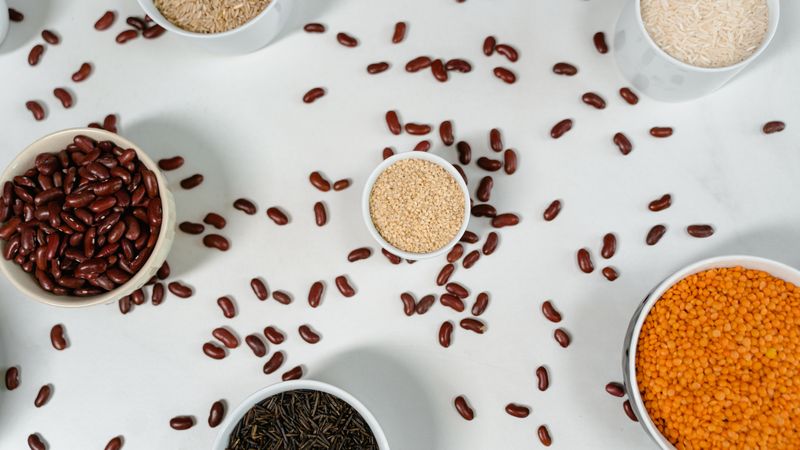
Photo: Grains and rice in ceramic bowls on a white surface by MART PRODUCTION, via Pexels (Pexels license).
Frequently asked questions
Do you need to boil lentils?
Yes. Bring them to a boil in about 3 cups of water per cup of lentils, then cover and simmer until tender: about 15 to 20 minutes for whole lentils and 5 to 7 minutes for split red lentils, according to Lentils.org.
Do you have to soak lentils before cooking?
No. Lentils.org and USA Pulses both say lentils don't need soaking. Rinse them and pick out any debris. Dried beans and chickpeas are the ones to soak.
Why are my lentils still crunchy after cooking?
Usually the lentils are old, salt or acid went in too early, or they need more time. Lentils.org says salt added at the start makes lentils tough. Add hot water if the pot looks dry, keep simmering and taste every 5 minutes.
What is the best seasoning for lentils?
Flavor the cooking water with broth, garlic, a bay leaf, herbs or whole spices, then add salt and a splash of vinegar or lemon juice at the end. Lentils.org advises adding salt and vinegar only after the lentils are cooked.
Do you have to rinse quinoa?
Only if the package doesn't say it's pre-rinsed. Quinoa has a bitter natural coating called saponins. Bob's Red Mill, for example, rinses and air-dries its quinoa to remove them before packing.
Should you rinse rice before cooking?
USA Rice says rice grown in the U.S. doesn't need rinsing, and that rinsing enriched white rice washes away some of the added vitamins and minerals. Follow the directions on your package.
How long does it take to cook dried beans?
Soaked beans usually take 1 to 2 hours at a low simmer, and soaked chickpeas 1 1/2 to 2 hours, according to USA Pulses. In a pressure cooker, unsoaked black or pinto beans take about 25 minutes at high pressure plus a natural release of at least 20 minutes.